Father Rentería's moral and religious crisis
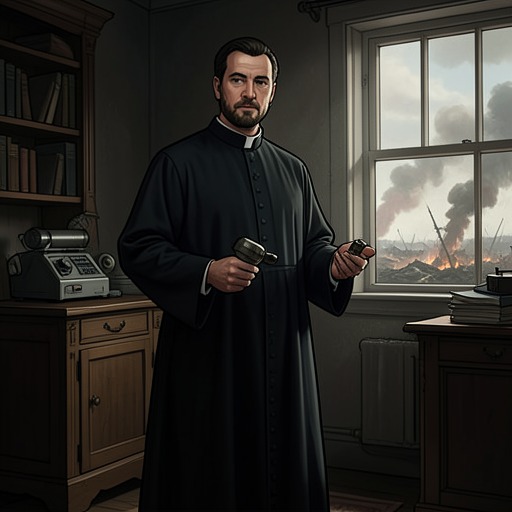
Pedro PáramoFather Rentería's crisis is the conflict between the spiritual judgment he is meant to exercise and the worldly power that shapes what he dares to do. He knows the harm committed by Miguel Páramo and the failures he has excused in life, yet at Miguel's funeral he gives the blessing after Pedro Páramo offers gold. The compromise does not end with the ceremony: in private, the priest revisits the poor people whose faith he has failed and wonders what salvation means when mercy appears constrained by money and fear.
The priest and the limits of his authority
Father Rentería serves a community in which religious rites remain visible, but their power to console or absolve is uncertain. His crisis is not simply doubt about doctrine. He continues to speak in the language of sin, grace, heaven, and divine judgment; what unsettles him is his own participation in a system where the wealthy can press their claims while the poor cannot afford the services that might help them.
That contradiction comes into focus at Miguel Páramo's funeral. The priest condemns Miguel as a man who died without absolution, beyond the reach of grace, and turns away from the body as if the Mass were over. He leaves without blessing the congregation. When mourners insist that Miguel's body be blessed, he refuses, arguing that Miguel was wicked and should not enter heaven. Yet the narrated scene already exposes the strain in his stance: his hands tremble, and the priest does what he has just said he will not do.
Miguel's funeral and Pedro's gold
The funeral places the priest's judgment beside the power of Miguel's father. Miguel lies on a catafalque in the church, surrounded by new candles and flowers; Pedro Páramo waits alone behind him. After the service, Pedro kneels beside Father Rentería and acknowledges the grievances against his son: the murder of the priest's brother, Miguel's assault on Ana, and other offenses. He asks the priest to set those injuries aside and forgive Miguel as God may have done.
Pedro leaves a handful of gold coins on the prie-dieu as an offering for the church. Father Rentería takes the coins one by one to the altar. He asks God to accept them and determine what salvation may cost, then asks for justice—or injustice—and for Miguel's condemnation. The prayer refuses to turn the transaction into a clean reconciliation: the priest accepts the money and carries out the rite, but does not present the payment as proof that Miguel deserves pardon. The burial proceeds, with four Media Luna cowhands carrying the coffin and Pedro leaving with two men who had waited at the church door.
Afterward, Father Rentería shuts the tabernacle, goes into the sacristy, and collapses in a corner, weeping in pain and sorrow. The collapse gives the ceremony its private aftermath. Publicly, he has performed the blessing demanded by the mourners and enabled by Pedro's donation; privately, he cannot settle whether he has served the Church, the powerful father, or the dead man whose sins he had condemned.
The poor, Eduviges, and a conscience that will not rest
That night Father Rentería tosses in bed and turns the funeral into an accusation against himself. He thinks that everything is his fault: he fears offending the people who sustain him, admits that they maintain him, and contrasts their money with the poor people's prayers, which do not fill his stomach. He understands his dependence as a betrayal of those who love him, trust him, and hope that he will intercede for them before God. His question is not whether the poor have faith, but what that faith has gained them when the priest's help is compromised.
His thoughts return to María Dyada's plea that he save her sister Eduviges Dyada. María had described Eduviges as generous to others, hospitable even to men who exploited her, and abandoned by the fathers of the children she bore. Father Rentería had refused to absolve Eduviges because she died by suicide, treating her final act as a failure that outweighed her goodness. María had answered that her sister had no other way out and had died in terrible suffering. Now that memory challenges the priest's confidence in his own judgment: he recalls Eduviges's suffering and María's appeal, but he had offered no assurance that either prayer or costly Masses could help.
The exchange over money sharpens the moral imbalance. María says she cannot pay for the high Masses that would require a deacon and subdeacon. The priest lets the matter rest and tells her to entrust it to God. In bed, however, he cannot keep that response from becoming evidence against himself. He wonders how little it would cost him to say the words that might save a soul, and whether he truly knows enough about heaven and hell to condemn the dead so readily. To quiet himself, he begins reciting the names of saints, then recognizes that he is counting them like sheep. Prayer and habit offer no firm resolution; the star-filled sky outside brings no consoling clarity.
Contla: confession refused
Father Rentería's attempt to confront his own guilt at Contla ends in a judgment he cannot evade. He had gone to make a general confession to the parish priest there, who refused him absolution despite his pleas. The other priest names the failure plainly: Father Rentería let a powerful man trample the Church and cannot expect goodness in himself or the people to repair that surrender. The inhabitants may still believe, the confessor argues, but their faith cannot be credited to the priest if it rests on superstition and fear.
The refusal is not presented as a rejection of the priest's daily labor. The confessor recognizes the hardship of serving poor villages and the care with which Father Rentería carries out his duties. But sympathy does not substitute for absolution: a priest whose hands are not sufficiently clean cannot absolve himself through routine service, and must seek forgiveness elsewhere. Father Rentería asks whether this means confessing to someone other than his own confessor and is told to let God judge the dead. When he presses for a direct answer, the answer remains no.
Even so, he submits rather than argues. He describes himself as a poor man prepared to bend when necessary, takes the confessor's hands, and kisses them. Back in his own parish, he tries not to think about that morning. The contrast is stark: in Comala, he has bent to the demands of Pedro Páramo; at Contla, he bends before a priest who names that submission as a spiritual failure.
Rites without assurance
The crisis reappears in the confessional. While listening to another woman's Confiteor, Father Rentería's head droops; dizziness, confusion, a sensation of dissolving in thick water, flashes of light, and the taste of blood interrupt his attention. The prayer continues and repeats, but the passage does not offer a clear explanation for his physical distress. He cries out for the woman to be quiet and asks how long it has been since her last confession, then remains overwhelmed by misfortune and tells himself that he is exhausted and should rest.
He leaves the confessional and tells those waiting that anyone who considers themselves without sin may receive Communion the next day. The announcement shifts the burden of judgment onto the parishioners at precisely the moment when his own authority is shaken. It does not resolve whether he can distinguish the guilty from the worthy, or whether anyone can approach the sacrament with confidence under such a standard.
Elsewhere in Comala, funeral ritual also slips beyond the meanings it is meant to contain. On the morning of December 8, bells ring from several churches, continue through the day and night, and sound for three days; people arrive from Contla and farther away, and the mourning for Susana San Juan turns into a crowded celebration. The Media Luna remains silent as Susana is buried, while Comala fills with music, vendors, and cockfights. This episode does not record Father Rentería's response, but it sets the religious and communal world of his crisis in sharp relief: bells and rites persist, yet grief, celebration, power, and faith do not settle into a single shared meaning.